No whales off the Catalan coast due to drought
Since 2017 that a whale with its calf was not seen near the Catalan coasts and this year it has been possible. But this image contrasts with the fact that the presence of common rorquals, the most characteristic whale of the Mediterran…
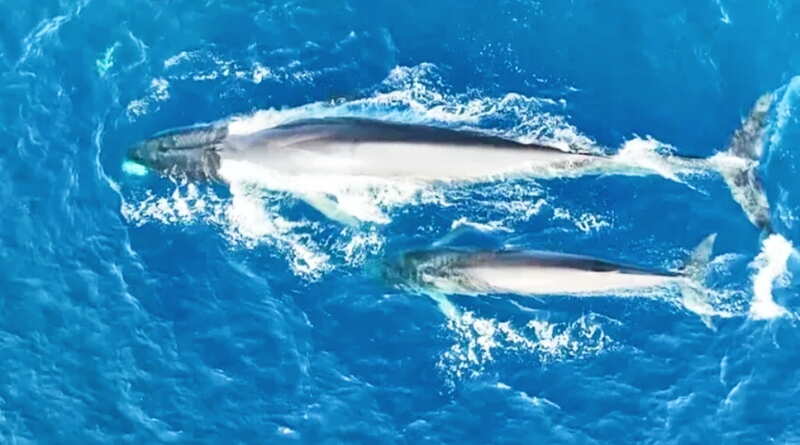
Since 2017 that a whale with its calf was not seen near the Catalan coasts and this year it has been possible. But this image contrasts with the fact that the presence of common rorquals, the most characteristic whale of the Mediterranean, has been drastically reduced.
A decade ago that the Catalan NGO Edmaktub Association is dedicated to the observation and study of whales. This 2023, however, they have been forced to put an end to their project in the middle of the season. They have not sighted any whales for more than a month. In total, they were able to identify about thirty whales. This is 75% less than last year.
Eduard Degollada Bastos, scientist and president of the Edmaktub Association, is very clear that the cause is drought.
"It has been a very dry year, it has not rained during the winter and this has meant that the cycle that makes algae, plankton and specifically krill, which is what the whales feed on, has not occurred."
Usually the common Rorqual is in Catalan waters during the spring period. Now, but, its route has changed and is totally uncertain. Beatriu Tort, researcher of the Association Edmaktub explains it to us.
"Migratory animals follow very specific routes -- in winter I go to one place and then in summer I move to another place -- and it has been seen that these years that there are these climatological changes have made that, as in the end what they are looking for is to eat, if they don't find it here they will go somewhere else."
The collision against cargo ships is the main threat to whales that make route passing through the Catalan coasts, mainly because of the high maritime traffic between the Port of Barcelona and Tarragona. Now, however, the lack of food due to the drought puts even more on the ropes an animal that is already in danger of extinction, especially in Mediterranean waters. They are part of the red list of the IUCN, the International Union for Conservation of Nature.
Scientists are concerned about a situation that is totally new and that, if prolonged, could have serious consequences:
"The problem that this continues and repeats itself every year, that there is drought in winter, it is the same if it then rains very much in May because then it is already late because the temperature has risen a lot and the microorganisms cannot multiply, this will obviously be a serious problem in the face of the whales ending up not entering the Mediterranean, so that, if they do not enter, it means that this part of the population will be reduced and possibly become extinct."
Although there are those who complain when it only rains at sea, scientific studies have long pointed out that the water discharged into the seas and oceans is a key element in the balance of the marine ecosystem. Now, this change in the whales' migratory route is interpreted as another indicator of the climate crisis.
"It's like a chain; when one point fails, it has repercussions for everything. Everything means whales, but also dolphins, fish, birds, in the end it is everything and everything also includes us humans".
After such a short and poor whale watching season, now, the uncertainty forces to look for new horizons to continue studying the future of the Rorqual common whale, the second largest whale in the world.
In fact, the ship Maktub, the operational base of the Edmaktub Association, will now set course for Denia, in the Valencian Country, where some specimens have been seen recently. The objective is to follow the coast of the Iberian Peninsula to finish in Galicia in August. A whale watching route so far unpublished.
Image: A whale swims with its calf beside it, an image that had not been seen since 2017 in Catalan waters (Edmaktub Association)